
 45 Lessons
 1.2K Students





Pushpanathan Kulandavel
Very helpful
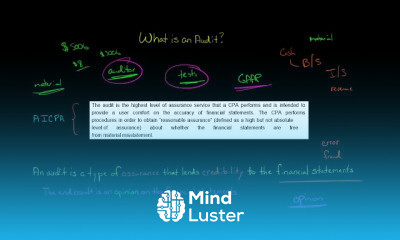
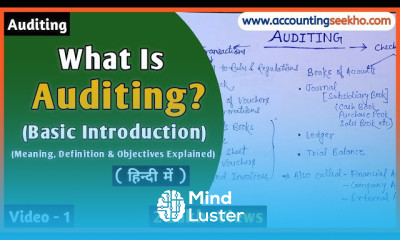
Auditing is defined as the on-site verification activity, such as inspection or examination, of a process or quality system, to ensure compliance to requirements. An audit can apply to an entire organization or might be specific to a function, process, or production stepWhat is the purpose of auditing? The purpose of an audit is to form a view on whether the information presented in the financial report, taken as a whole, reflects the financial position of the organisation at a given date, for example: Are details of what is owned and what the organisation owes properly recorded in the balance sheet?What are the 3 types of audits? There are three main types of audits: external audits, internal audits, and Internal Revenue Service (IRS) audits. External audits are commonly performed by Certified Public Accounting (CPA) firms and result in an auditor's opinion which is included in the audit report.
 To Register in Course you have to watch at least 30 Second of any lesson
 Conduct comprehensive on-site inspections to verify organizational compliance with quality standards and regulatory requirements
Perform detailed examinations of financial statements to assess accuracy, transparency, and adherence to accounting principles
Identify and evaluate risks within processes and systems to recommend effective internal controls and mitigation strategies
Apply auditing techniques to assess operational efficiency and detect potential areas of fraud or misstatement
Utilize audit tools and software to streamline data collection, analysis, and reporting processes
Develop clear, concise audit reports that communicate findings, compliance status, and improvement recommendations
Differentiate between external, internal, and IRS audits to tailor audit approaches for various organizational needs
Implement best practices for planning, executing, and documenting audit procedures in diverse organizational contexts
Assess organizational processes for compliance with legal, regulatory, and industry-specific standards
Evaluate the effectiveness of internal controls and governance frameworks to enhance organizational integrity
Use risk-based auditing methods to prioritize audit activities and optimize resource allocation
Apply ethical standards and professional judgment to maintain integrity and objectivity throughout the audit process
45 Lessons • 3 h 19 m total

 You must have an
Account
on the platform.
Complete all lessons.
Watch at least 50% of Lesson Duration.
Get your Certificate free 🎉 !
4.4
 (136 reviews)
Overall rating

Be the First One Review This Course
Very helpful

This course is helpful to me

good

Amazing voice for teaching 👌

good
Fantastic
I am Happey
HELPFUL

GOOD TUITORS
Good

Good
nice

Auditing is defined as the on-site verification activity, such as inspection or examination, of a process or quality system, to ensure compliance to requirements. An audit can apply to an entire organization or might be specific to a function, process, or production stepWhat is the purpose of auditing? The purpose of an audit is to form a view on whether the information presented in the financial report, taken as a whole, reflects the financial position of the organisation at a given date, for example: Are details of what is owned and what the organisation owes properly recorded in the balance sheet?What are the 3 types of audits? There are three main types of audits: external audits, internal audits, and Internal Revenue Service (IRS) audits. External audits are commonly performed by Certified Public Accounting (CPA) firms and result in an auditor's opinion which is included in the audit report.
Experience the full power of Mindluster with Premium.
No distractions, just pure education.
Cancel your subscription anytime