


areeba sohail
Was absolutely good
 (129 reviews)
 14 Lessons
 207 Students
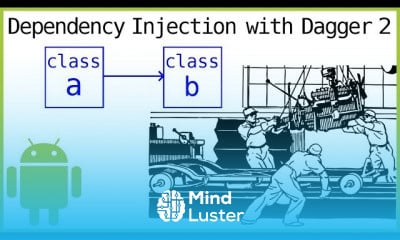
What is dagger module? Modules are a way of telling Dagger how to provide dependencies from the dependency graph. These are typically high level dependencies that you aren't already contributing to the dependency graph through the @Inject constructor annotation we discussed in our previous article.How does a dagger work? Dagger generates code similar to what you would have written manually. Internally, Dagger creates a graph of objects that it can reference to find the way to provide an instance of a class. For every class in the graph, Dagger generates a factory-type class that it uses internally to get instances of that type.What is dagger 2 used for? Dagger 2 walks through the dependency graph and generates code that is both easy to understand and trace, while also saving you from writing a large amount of boilerplate code you would normally need to write by hand to obtain references and pass them to other objects as dependencies.Why should we use dagger? Why dagger-android? The idea behind dagger-android is to reduce the boilerplate needed to inject objects. To be even more specific, the idea is to reduce that boilerplate code in Fragments, Activities or any other Android framework classes that are instantiated by the OS.What is the use of dagger in Android? In Android, you usually create a Dagger graph that lives in your application class because you want an instance of the graph to be in memory as long as the app is running. In this way, the graph is attached to the app lifecycle. In some cases, you might also want to have the application context available in the graph.
 To Register in Course you have to watch at least 30 Second of any lesson
 Master how Dagger 2 modules provide dependencies in Android applications using dependency injection techniques and annotations
Implement Dagger 2 dependency graphs to efficiently manage object creation and lifecycle in Android projects
Utilize Dagger 2 factories and generated code to simplify dependency management and reduce boilerplate in Android development
Apply Dagger 2 in Android to inject dependencies into Activities, Fragments, and other framework classes effectively
Analyze the benefits of Dagger 2 and Dagger-Android for scalable, maintainable, and testable Android applications
Configure and integrate Dagger 2 modules and components within Android application architecture
Troubleshoot common issues in Dagger 2 dependency injection and optimize dependency graphs for performance
Develop best practices for using Dagger 2 to enhance code readability, modularity, and dependency management in Android apps
14 Lessons • 2 h 11 m total
 You must have an
Account
on the platform.
Complete all lessons.
Watch at least 50% of Lesson Duration.
Get your Certificate free 🎉 !
4.1
(129 reviews)
Overall rating

Be the First One Review This Course
Was absolutely good

Marcos Roberto Perez Pino

https://t.me/mindluster/484

What is dagger module? Modules are a way of telling Dagger how to provide dependencies from the dependency graph. These are typically high level dependencies that you aren't already contributing to the dependency graph through the @Inject constructor annotation we discussed in our previous article.How does a dagger work? Dagger generates code similar to what you would have written manually. Internally, Dagger creates a graph of objects that it can reference to find the way to provide an instance of a class. For every class in the graph, Dagger generates a factory-type class that it uses internally to get instances of that type.What is dagger 2 used for? Dagger 2 walks through the dependency graph and generates code that is both easy to understand and trace, while also saving you from writing a large amount of boilerplate code you would normally need to write by hand to obtain references and pass them to other objects as dependencies.Why should we use dagger? Why dagger-android? The idea behind dagger-android is to reduce the boilerplate needed to inject objects. To be even more specific, the idea is to reduce that boilerplate code in Fragments, Activities or any other Android framework classes that are instantiated by the OS.What is the use of dagger in Android? In Android, you usually create a Dagger graph that lives in your application class because you want an instance of the graph to be in memory as long as the app is running. In this way, the graph is attached to the app lifecycle. In some cases, you might also want to have the application context available in the graph.
Experience the full power of Mindluster with Premium.
No distractions, just pure education.
Cancel your subscription anytime