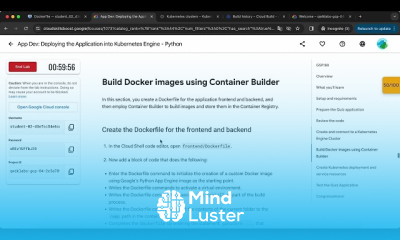
Creating google kubernetes engine deployments Course

 (101 reviews)
-
 43 Lessons
-
 10 Students
- Certificate of completion


Creating google kubernetes engine course, in this course we will learn about Creating Google Kubernetes Engine (GKE) Deployments, focusing on how to effectively deploy and manage containerized applications using GKE, a powerful, fully managed Kubernetes service on Google Cloud. Kubernetes is an open-source platform for automating deployment, scaling, and management of containerized applications, and GKE simplifies this process by providing a managed environment. The course covers key topics such as setting up a Kubernetes cluster on GKE, configuring deployments, and defining the necessary resources, including CPU and memory, to ensure optimal performance. You will learn how to create and manage deployments that automatically handle scaling, rolling updates, and failover, ensuring that your applications are resilient and can handle varying levels of demand. Additionally, the course will explore best practices for managing the lifecycle of your applications, including monitoring, logging, and troubleshooting within GKE. You’ll also learn how to integrate GKE with other Google Cloud services to build comprehensive, scalable cloud solutions. By the end of this course, you will have the skills to create and manage robust GKE deployments, allowing you to leverage the power of Kubernetes to deploy, scale, and maintain your applications efficiently in the cloud. Whether you're new to Kubernetes or looking to refine your skills, this course will provide the knowledge needed to succeed with GKE.
 To Register in Course you have to watch at least 30 Second of any lesson
What You'll Learn
-
 Master how to set up and configure Google Kubernetes Engine clusters for containerized application deployment
-
Implement scalable GKE deployments with automated scaling, rolling updates, and failover strategies
-
Optimize resource allocation by defining CPU, memory, and storage requirements for GKE applications
-
Manage application lifecycle through monitoring, logging, and troubleshooting within Google Cloud GKE environment
-
Deploy and update containerized applications efficiently using Kubernetes deployment strategies on GKE
-
Integrate GKE with other Google Cloud services to build comprehensive, scalable cloud solutions
-
Apply best practices for securing GKE clusters and managing access controls effectively
-
Utilize Kubernetes manifests and Helm charts to streamline deployment and configuration processes
-
Implement health checks and readiness probes to ensure application resilience and uptime in GKE
-
Automate deployment workflows using CI/CD pipelines integrated with Google Cloud tools
-
Monitor GKE clusters and applications using Google Cloud Monitoring and Logging tools
-
Troubleshoot common issues in GKE deployments to maintain high availability and performance
Course Content
43 Lessons • 6 h 40 m total

App Dev Deploying the Application into Kubernetes Engine Python GSP188
Deploying Google Kubernetes Engine Clusters from Cloud Shell
Google Kubernetes Engine Security Binary Authorization GSP479
Setting up a Private Kubernetes Cluster GSP178
Using a NAT Gateway with Kubernetes Engine GSP162
Configuring Persistent Storage for Google Kubernetes Engine
Autoscaling TensorFlow Model Deployments with TF Serving and Kubernetes GSP777
Distributed Load Testing Using Kubernetes GSP182
Cloud Logging on Kubernetes Engine GSP483
Deploying Memcached on Kubernetes Engine GSP116
Using Cloud Trace on Kubernetes Engine GSP484
How to Use a Network Policy on Google Kubernetes Engine GSP480
Hello Node Kubernetes GSP005
Deploying Jobs on Google Kubernetes Engine
Working with Google Kubernetes Engine Secrets and ConfigMaps
Using Role based Access Control in Kubernetes Engine GSP493
Securing Google Kubernetes Engine with Cloud IAM and Pod Security Admission
Continuous Delivery with Jenkins in Kubernetes Engine GSP051
Orchestrating the Cloud with Kubernetes AWS GSP1120
Running a Containerized App on Google Kubernetes Engine GSP015
Migrating a Monolithic Website to Microservices on Google Kubernetes Engine GSP699
Managing Deployments Using Kubernetes Engine GSP053
Kubernetes Engine Qwik Start GSP100
Google Kubernetes Engine Pipeline using Cloud Build GSP1077
Running a MongoDB Database in Kubernetes with StatefulSets GSP022
Installing Anthos Service Mesh on Google Kubernetes Engine GSP654
Connect to Cloud SQL from an Application in Kubernetes Engine GSP449
Orchestrating the Cloud with Kubernetes GSP021
Deploy Kubernetes Load Balancer Service with Terraform GSP233
CI CD for Google Kubernetes Engine using Cloud Build
Deploying Google Kubernetes Engine
Creating Google Kubernetes Engine Deployments
Deploying Google Kubernetes Engine Clusters from Cloud Shell
App Dev Deploying the Application into Kubernetes Engine Node js
Awwvision Cloud Vision API from a Kubernetes Cluster GSP066
Deploy Scale and Update Your Website on Google Kubernetes Engine GSP663
Orchestrating the Cloud with Kubernetes Azure GSP1121
Deploy to Kubernetes in Google Cloud Challenge Lab GSP318
Build and Deploy a Docker Image to a Kubernetes Cluster Challenge Lab GSP304
Manage Kubernetes in Google Cloud Challenge Lab GSP510

How to Get The Certificate
-
You must have an
Account
on the platform.
-
Complete all lessons.
-
Watch at least 50% of Lesson Duration.
-
Get your Certificate free 🎉 !
4.0
(101 reviews)
Overall rating

Reviews
Be the First One Review This Course
Related Courses
View All












Creating google kubernetes engine deployments Course Description
Creating google kubernetes engine course, in this course we will learn about Creating Google Kubernetes Engine (GKE) Deployments, focusing on how to effectively deploy and manage containerized applications using GKE, a powerful, fully managed Kubernetes service on Google Cloud. Kubernetes is an open-source platform for automating deployment, scaling, and management of containerized applications, and GKE simplifies this process by providing a managed environment. The course covers key topics such as setting up a Kubernetes cluster on GKE, configuring deployments, and defining the necessary resources, including CPU and memory, to ensure optimal performance. You will learn how to create and manage deployments that automatically handle scaling, rolling updates, and failover, ensuring that your applications are resilient and can handle varying levels of demand. Additionally, the course will explore best practices for managing the lifecycle of your applications, including monitoring, logging, and troubleshooting within GKE. You’ll also learn how to integrate GKE with other Google Cloud services to build comprehensive, scalable cloud solutions. By the end of this course, you will have the skills to create and manage robust GKE deployments, allowing you to leverage the power of Kubernetes to deploy, scale, and maintain your applications efficiently in the cloud. Whether you're new to Kubernetes or looking to refine your skills, this course will provide the knowledge needed to succeed with GKE.
Focus on Learning, Not Ads
Experience the full power of Mindluster with Premium.
No distractions, just pure education.
Cancel your subscription anytime
